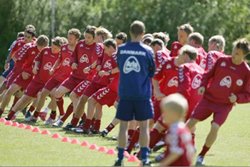
En mi opinión, el posible futuro (y presente) de la cuantificación de las cargas competitivas y gran parte del entrenamiento. He escogido este vídeo, no por el modelo/marca de la tecnología en cuestión, si no por lo ilustrativo de su utilidad. Confieso que para mi, es una inquietud constante las posibilidades de aplicación al rendimiento, y la aparición de sistemas de acelerometría y software específico de valoración en el entorno de los deportes colectivos.
24 ene 2009

18 ene 2009
¿Existe una carga óptima para el entrenamiento de la potencia? (III) En contra (Con)
Segunda parte del artículo (ver primera parte e Introducción en las dos entradas previas de Enero)
Does an Optimal Load Exist for Power Training?
Copyright (c) 2000-2008 Ovid Technologies, Inc.
Does an Optimal Load Exist for Power Training?
SUMMARY
MECHANICAL POWER CONTRIBUTES TO SUCCESS OF MOVEMENTS RANGING FROM ACTIVITIES OF DAILY LIVING TO SPORT TASKS. RESEARCHERS HAVE ATTEMPTED TO DETERMINE THE LOAD THAT MAXIMIZES MECHANICAL POWER. HOWEVER, DOES TRAINING AT THIS LOAD MAXIMIZE POWER ADAPTATIONS?
CON
Power is an instantaneous quantity derived from the product of force and velocity. Velocity refers to the speed of the moving body, not how quickly force is developed. Because of the inverse, nonlinear relationship between force and velocity during concentric muscle actions (as force increases, power decreases and vice versa), maximum power occurs at neither maximum force nor maximum velocity—but an optimal interaction between the 2. A prevalent training theory, backed by some early research, suggests that training at loads that produce the highest power outputs will lead to the greatest increases in ability to produce power during athletic performance (6). The optimal load for developing power has, as a result, in many ways become the Holy Grail of resistance training programs. However, there are at least 4 compelling reasons to give up this quest.
First, there is no definitive answer as to what the optimal load to develop power ought to be. There is considerable variability in the load found to maximize power output. Maximal power outputs have been reported to occur at loads as low as 10% of a 1 repetition maximum (1-RM) (8) to as heavy as 70% of a 1-RM (1). This large variability may be explained by the potential problems associated with measuring peak power and even the very nature of mechanical power in human movement itself.
Methodological inconsistencies associated with identifying loads producing peak power outputs are abound (3). Power can be calculated using displacement-only data, force-only data, or a combination of the two; each method has its own errors and limitations. Decisions to treat the subject and the external resistance as either a single system or 2 separate systems, to analyze all planes or just the predominant plane of movement, and even the determination of which/how many loads to use, have not been standardized and prevent a clear relation between load and peak power from being ascertained.
Even if a clear relationship between load and peak power can be identified, it is unlikely that a single load will produce peak power that is substantially greater than all others. Power is the instantaneous product of force and velocity. Theoretically, power may be the same for two different loads because the movement velocity would be higher for the lighter load, yet lower for the heavier load. Practically, there were no significant differences between power outputs achieved during jump squats with loads between 48% and 63% of a 1-RM (2). Similarly, there was no difference in power outputs during hang power cleans performed with loads between 50% and 90% of 1-RM (5). These results suggest that there may be no optimal load, but rather a range of resistances that maximize peak power.
Second, even if there were a single load that maximized peak power, it may be irrelevant because peak power may be an inappropriate parameter to try to maximize during training. Peak power represents a single instant in time during the movement, and may not be reflective of the demands of the movement as a whole. There is a low correlation between peak power and the time taken to complete speed repetitions during the squat (4). After a period of training, peak power in the jump squat may increase without a concomitant increase in jump height (7). While there is some evidence to the contrary (3), average power has a high correlation with tasks performed at a high rate of speed and may be more reflective of demands during the entire movement.
Third, the load that produces maximum power may not provide the greatest transfer to tasks that have different load or velocity requirements. Most athletes (with the exception of weightlifters and power lifters) use resistance exercise as a means to an end—improvement in their chosen sport. Power is the product of force and velocity. For some activities, force may be the dominant contributor to power generated; for others, it may be velocity. Since the greatest improvements in power are specific to the resistances used in training (6), the goal of training should not be to maximize power, but to maximize power output at the resistances found in an athlete's sport. Certain athletes may need to develop power against heavy resistances (e.g., football linemen), whereas others may need to develop power against lighter resistances (e.g., baseball pitchers). And some athletes may need to develop power across a wide spectrum of resistances (e.g., mixed martial artists). Surely, these athletes need to be trained differently.
Fourth, an optimal load for developing power (if one exists) may vary from one person to the next, even if they play the same sport. Improving maximum strength using heavy loads may be the best method for improving power in a relatively weak individual (8), whereas a relatively strong individual may need to switch to more explosive training at lighter resistances to improve power. This information will never be ascertained by examining group mean data resulting from training studies: the “most effective” program is rarely “one size fits all.” Group mean data need to be generalized only to a population that is homogenous with the sample.
In conclusion, there is no compelling scientific evidence to suggest that there is a single, optimal load to develop power. It has been generally accepted for many years that there is no “optimal” load to develop strength. Rather, a variety of training loads should be used in a periodized fashion to elicit superior strength gains. Why should power development be any different?
Sean P Flanagan, PhD, ATC, CSCS
California State University-Northridge, Northridge, California
REFERENCES
1. Baker, D, Nance, S, and Moore, M. The load that maximizes the average mechanical power output during explosive bench press throws in highly trained athletes. J Strength Cond Res 15: 20–24, 2001.
2. Baker, D, Nance, S, and Moore, M. The load that maximizes the average mechanical power output during jump squats in power-trained athletes. J Strength Cond Res 15: 92–97, 2001.
3. Dugan, EL, Doyle, TLA, Humphries, B, Hasson, CJ, and Newton, RU. Determining the optimal load for jump squats: A review of methods and calculations. J Strength Cond Res 18: 668–674, 2004.
4. Flanagan, SP and Salem, GJ. The validity of summing lower extremity individual joint kinetic measures. J Appl Biomech 21: 181–188, 2005.
5. Kawamori, N, Crum, AJ, Blumert, PA, Kulik, JR, Childers, JT, Wood, JA, Stone, MA, and Haff, GG. Influence of different relative intensities on power output during the hang power clean: Identification of the optimal load. J Strength Cond Res 19:698–708, 2005.
6. Kawamori, N and Haff, GG. The optimal training load for the development of muscular power. J Strength Cond Res 18: 675–684, 2004.
7. Mcbride, JM, Triplett-McBride, T, Davie, A, and Newton, RU. The effect of heavy- vs. light-load jump squats on the development of strength, power, and speed. J Strength Cond Res 16: 75–82, 2002.
8. Stone, MH, O'Bryant, HS, McCoy, L, Coglianese, R, Lehmkuhl, M, and Schilling, B. Power and maximum strength relationships during performance of dynamic and static weighted jumps. J Strength Cond Res 17: 140–147, 2003.
Copyright (c) 2000-2008 Ovid Technologies, Inc.
¿Existe una carga óptima para el entrenamiento de la potencia? (I I) A favor (Pro)
Primera parte del artículo (ver introducción en la entrada anterior):
Does an Optimal Load Exist for Power Training?
Does an Optimal Load Exist for Power Training?
SUMMARY
MECHANICAL POWER CONTRIBUTES TO SUCCESS OF MOVEMENTS RANGING FROM ACTIVITIES OF DAILY LIVING TO SPORT TASKS. RESEARCHERS HAVE ATTEMPTED TO DETERMINE THE LOAD THAT MAXIMIZES MECHANICAL POWER. HOWEVER, DOES TRAINING AT THIS LOAD MAXIMIZE POWER ADAPTATIONS?
Loren Z.F. Chiu, MS, CSCSColumn EditorPRO
Power training using different loads causes specific changes to the force–velocity relationship that creates variability in the degree to which power output is improved. Several investigations have indicated that training with the load that maximizes power output is more effective at improving maximal power production and athletic performance than either lighter or heavier loading conditions (5, 7, 8). Kaneko et al. (7) examined 4 loading conditions; 0% of maximum isometric strength (Po), 30% Po (the load that maximized power output), 60% Po, and 100% Po. After 12 weeks of elbow flexor training, maximal power production was improved in the 30% Poo and 60% Po groups (26.1% versus 13.8% and 21.7%, respectively) and to a greater extent than the 100% Po group (22.4%). Thus, training with the load that maximized power output promoted all-round improvements to the force–velocity relationship (i.e., increased both maximum velocity and maximum force output), which translated into the most pronounced improvement maximal power output (7). Similarly, Häkkinen et al. (5) reported that explosive body weight jump training (load equivalent to approximately 30% of maximal dynamic strength—the load that maximizes power output in the jump squat [3]) resulted in a 21% increase in jump height after 6 months of training, whereas heavy resistance training (70–120% of 1RM in the squat) resulted in a significantly lower improvement of 7%. Although no doubt exists that increasing an athletes strength level through heavy resistance training directly impacts the ability to generate high power outputs, little evidence exists demonstrating that heavy resistance training is more effective at increasing maximum power than training with the load that maximizes power output. group significantly more so than both the 0% P
More recently, a hybrid theory of combined training using multiple loads has been hypothesized to improve adaptations after power training to a greater extent than single-load programs. Harris et al. (6) compared the effects of high-force (80–85% of 1RM), high-power (30% of Po), and combined (30% of Po and 80–85% of 1RM) lower body training programs. After 12 weeks of training, the high-force group displayed no change in vertical jump peak power or jump height whereas a significant training effect existed for both the high-power and combined groups. No differences existed between the adaptations of the high-power and combined groups, with very similar improvements observed in peak power (2.5% and 2.6%, respectively) and jump height (2.3 cm and 1.8 cm, respectively). Furthermore, an examination of the elbow flexors in untrained males revealed that combined training using 100% and 30% of Po resulted in a significantly greater improvement in maximum power than training with 0% and 30% of Po10). It is unclear whether similar results would be observed in trained athletes or if the combined training program was compared to single-load training at the load that maximized power output (30% of Po). It is important to note that no evidence of work performed by the different training groups was provided in either investigation and thus it is difficult to delineate whether the loading conditions or the magnitude of the stimulus applied contributed to these observations. Furthermore, the impact of combined training has yet to be examined in a trained subject population where the potential for increasing maximal strength is diminished. (19.5% versus 10.0% improvement, respectively) (
Although the exact physiological mechanisms underlying superior adaptations after training with a specific load remain unidentified, it is theorized that the load that maximizes power output provides a stimulus that elicits the greatest improvement in power production due to specific adaptations in neural activation patterns (5,7,8). Several investigations have observed increases in muscle activity to occur at the specific load and movement velocity used in training (5,8). This suggests an increase in neural drive through the selective recruitment of high threshold motor units, increased firing frequency, and/or synchronization of motor units. Because adaptations are most pronounced at the load used in training, the load that maximizes power output provides the best stimulus to elicit the physiological changes necessary to increase maximal power output. Changes in muscle fiber contractile properties have also been postulated to contribute to adaptations following power training however little evidence to this effect currently exists.
A major obstacle to the identification of an optimal load has been the variety of methodologies used to measure power output (2,4). As a consequence, large disparities in the optimal load have been reported leading to ambiguity surrounding the load-power relationship (1,9). Methods reliant solely on kinematic (e.g., linear position transducer [LPT]) or kinetic (e.g., force plate) data have limitations when used for the determination of power output in various movements (2). The combination of kinetic and kinematic equipment (i.e., force plate and LPT) should be used to obtain the most valid representation of muscle power generation during dynamic movements (2,4).
The current literature indicates the load that maximizes power output in a specific movement is the optimal training load to elicit improvements in maximal power output. This optimal load provides a stimulus that results in the greatest improvement in maximal power output due to velocity specific increases in neural drive. Although training with a combination of intensities may improve power output across a greater portion of the force–velocity relationship, the degree at which maximal power output is increased remains unclear. Further examination is necessary to elucidate if improvements to maximal power output and athletic performance differ between single-load and multiple-load training programs in which the total work performed in both programs is equivalent.
Prue Cormie, MS, CSCS
Edith Cowan University, Perth, Australia
REFERENCES
1. Baker, D, Nance, S, and Moore, M. The load that maximizes the average mechanical power output during jump squats in power trained athletes. J Strength Cond Res 15: 92–97, 2001.
2. Cormie, P, McCaulley, GO, and McBride, JM. Validation of power measurement in dynamic lower body resistance exercise. J Appl Biomech 23: 112–127, 2007.
3. Cormie, P, McCaulley, GO, Triplett, NT, and McBride, JM. Optimal loading for maximal power output during the jump squat, power clean and squat. Med Sci Sports Exerc 39: 340–349, 2007.
4. Dugan, EL, Doyle, TLA, Humphries, B, Hasson, CJ, and Newton, RU. Determining the optimal load for jump squats: A review of methods and calculations. J Strength Cond Res 18: 668–674, 2004.
5. Häkkinen, KP, Komi, V, and Alen, M. Effective of explosive type strength training on isometric force and relaxation time, electromyography and muscle fibre characteristics of leg extensor muscles. Acta Physiol Scand 125: 587–600, 1985.
6. Harris, GR, Stone, MH, O'Bryant, HS, Proulx, CM, Johnson, RL. Short-term performance effects of high power, high force, or combined weight-training methods. J Strength Cond Res 14: 14–20, 2000.
7. Kaneko, M, Fuchimoto, T, Toji, H, and Suei, K. Training effect of different loads on the force-velocity relationship and mechanical power output in human muscle. Scand J Med Sci Sports 5: 50–55, 1983.
8. McBride, JM, Triplett-McBride, T, Davie, A, and Newton, RU. The effect of heavy- vs. light-load jump squats on the development of strength, power, and speed. J Strength Cond Res 16: 75–82, 2002.
9. McBride, JM, Triplett-McBride, T, Davie, A, and Newton, RU. A comparison of strength and power characteristics between power lifters, Olympic lifters and sprinters. J Strength Cond Res 13: 58–66, 1999.
10. Toji, H, Suei, K, and Kaneko, M. Effects of combined training loads on relations among force, velocity, and power development. Can J Appl Physiol 22: 328–336, 1997.
17 ene 2009
¿Existe una carga óptima para el entrenamiento de la potencia? ( I ) Introducción
Dos cosas que nos ayudan a conformar nuestras opiniones y sentido crítico, son eso mismo: opiniones y críticas. Resulta reconfortante leer un artículo científico, (a veces incluso nos conformamos con el abstract obviando mucha información) y asimilar rápidamente unos resultados que parecen incontestables. Y qué decir, cuando nos dan una conferencia/clase/etc.. de las que te borran de un plumazo ciertas dudas que no dejaban despejar la incognita de una molesta "ecuación de conocimientos"; y piensas: ahora veo la luz. Pues resulta, que es más que probable que, no a muchos kilómetros de esa clase, no a muchas estanterías de donde está colocada esa revista, y no a muchos "http" de esa página de internet; encontremos una información quizás tan bien fundamentada como la que acabamos de recibir, pero con una dirección diferente o incluso opuesta. Los puntos de vista en el ámbito académico, cuando están bien fundamentados, resultan de lo más interesante sobre todo para tomar un poco de aquí y de allá, ayudándonos a no ser tan conformistas y si más reflexivos.
Utilizaré lo dicho en el párrafo anterior, para dar motivos a las dos próximas entradas, que consisten en no más de un artículo (repartido en ambas), más concretamente un Point/Counterpoint que pertenece al número de Abril de 2008 del Strenght and Conditioning Journal. Aprovecho para recomendar la lectura y consulta frecuente de esta revista para quien no lo realice, y que a mi parecer , aunque no tenga la rigurosidad de su "hermano" mayor, el Journal of Strenght and Conditioning Research, es una publicación que simpre tiene artículos con buena documentación, con buenas ideas, y que resulta en una mezcla de calidad, aporte de recetas bien fundamentadas, reflexión, y crítica.
El artículo, consiste en la argumentación por parte de los dos autores con diferentes puntos de vista sobre la pregunta que se plantea ¿Existe una carga óptima para el entrenamiento de la potencia?. Así, una opinión se fundamenta a favor (Pro) y la otra en contra (Con). Esta estructura de artículo, se repite en distintos números de la publicación, pero he escogido este, porque creo que es una pregunta que nos debemos hacer a la hora de cuantificar las cargas para el desarrollo de esta manifestación clave de la fuerza en los deportes. No me culpeis (centraros en el sistema educativo) si el texto está en inglés, está claro que es el idioma de divulgación científica, por lo que debemos obligarnos a leerlo para actualizarnos.
Como conclusión para dejar paso a las entradas con los textos, tras su lectura, considero que como decía más arriba, cogiendo un poco de aquí y de allá, los dos autores están más cerca entre sus opiniones de lo que que puede parecer, o al menos, parte de los conceptos se pueden compartir y tener en cuenta a la hora de cuantificar este tipo de cargas entrenantes. Es así, que los estudios que se citan en el Pro, y que aportaban datos sobre ganancias de potencia en entrenamientos con las cargas que registran los valores más altos de dicha manifestación, quizás también tengan resultados similares (apreciación personal) relacionándolo con lo que se concluye en el apartado Con, una desviación o variación de las cargas, ya que creo que no será demasiado viable entrenar con la carga de potencia óptima siempre, y que la dependencia de la variabilidad de acciones de la disciplina deportiva, también condiciona escoger distintas cargas relacionadas con distintos valores de potencia siempre que no constituyan entrenamiento vacío.
Utilizaré lo dicho en el párrafo anterior, para dar motivos a las dos próximas entradas, que consisten en no más de un artículo (repartido en ambas), más concretamente un Point/Counterpoint que pertenece al número de Abril de 2008 del Strenght and Conditioning Journal. Aprovecho para recomendar la lectura y consulta frecuente de esta revista para quien no lo realice, y que a mi parecer , aunque no tenga la rigurosidad de su "hermano" mayor, el Journal of Strenght and Conditioning Research, es una publicación que simpre tiene artículos con buena documentación, con buenas ideas, y que resulta en una mezcla de calidad, aporte de recetas bien fundamentadas, reflexión, y crítica.
El artículo, consiste en la argumentación por parte de los dos autores con diferentes puntos de vista sobre la pregunta que se plantea ¿Existe una carga óptima para el entrenamiento de la potencia?. Así, una opinión se fundamenta a favor (Pro) y la otra en contra (Con). Esta estructura de artículo, se repite en distintos números de la publicación, pero he escogido este, porque creo que es una pregunta que nos debemos hacer a la hora de cuantificar las cargas para el desarrollo de esta manifestación clave de la fuerza en los deportes. No me culpeis (centraros en el sistema educativo) si el texto está en inglés, está claro que es el idioma de divulgación científica, por lo que debemos obligarnos a leerlo para actualizarnos.
Como conclusión para dejar paso a las entradas con los textos, tras su lectura, considero que como decía más arriba, cogiendo un poco de aquí y de allá, los dos autores están más cerca entre sus opiniones de lo que que puede parecer, o al menos, parte de los conceptos se pueden compartir y tener en cuenta a la hora de cuantificar este tipo de cargas entrenantes. Es así, que los estudios que se citan en el Pro, y que aportaban datos sobre ganancias de potencia en entrenamientos con las cargas que registran los valores más altos de dicha manifestación, quizás también tengan resultados similares (apreciación personal) relacionándolo con lo que se concluye en el apartado Con, una desviación o variación de las cargas, ya que creo que no será demasiado viable entrenar con la carga de potencia óptima siempre, y que la dependencia de la variabilidad de acciones de la disciplina deportiva, también condiciona escoger distintas cargas relacionadas con distintos valores de potencia siempre que no constituyan entrenamiento vacío.
9 dic 2008
Fisiología de la fatiga desde la integración (II)
Primera parte de la mini-revisión (ver introducción en la entrada anterior):
Los orígenes de la fatiga durante el ejercicio físico como fenómeno biológico, ha intrigado a científicos de diferentes especialidades durante el último siglo, y ha resultado ser actualmente una rica pero compleja área de investigación. Es así, que durante estos años, los científicos han empleado una larga lista de procedimientos experimentales y protocolos, para entender los mecanismos fundamentales de la fatiga y su carácter limitante en el ejercicio físico. Debido a las implicaciones que tiene el fenómeno de la fatiga en distintos colectivos humanos y actividades, no es sorprendente que la investigación de las posibles causas precursoras haya reunido a campos de conocimiento y profesionales de las ciencias básicas, aplicadas y clínicas entorno al tema.
Las primeras investigaciones de los mecanismos de la fatiga, se centraron en la utilización y disponibilidad de sustratos metabólicos o bien, en la acumulación de productos de deshecho generados durante el ejercicio. El ejercicio prolongado fue así considerado, como de carácter limitado por la disponibilidad de glucógeno en el músculo y/o hipoglucemia. La fatiga durante el ejercicio intenso, ha sido atribuida típicamente como una consecuencia de la depleción de la creatina, y a la acidosis láctica. Con pruebas de que no disminuía el potencial de acción a través de la unión neuromuscular, la fatiga fue adscrita a los aspectos internos en la actividad de los músculos. Por lo tanto, el término “fatiga muscular” permanece ahora enclavado como parte del lenguaje científico común. Diferentes investigadores, con puntos de vista fundamentados por años de investigación en parcelas generalmente aisladas, confluyen de manera actual, en revisiones del estado de la cuestión, donde refuerzan el concepto de que el entendimiento de la fatiga pasa por su estudio a través de un modelo integrado (1). Indican así, que la “fatiga”, más que la “fatiga muscular” es un término mucho más apropiado para ejercicios de tipo voluntario, desde el momento en el que la limitación que conlleva la fatiga involucra a mecanismos en la contracción muscular periférica o locomotora y se acompasa con el funcionamiento de músculos respiratorios, perfusión muscular, otros músculos esqueléticos y órganos que regulan los sustratos energéticos, metabolitos, o la homeostasis iónica y, de manera más importante, con el sistema nervioso central. Es necesario entonces, realizar un repaso por esta bibliografía, para crear un punto de partida hacia un entendimiento de la fatiga.
Desde un punto de vista centrado en la fatiga a nivel mío-celular, recientemente se han revisado las pruebas existentes sobre el fallo en la liberación de Ca2+ desde el retículo sarcoplasmático como una causa mayor en la fatiga del músculo (2). La revisión contempla experimentos en fibras aisladas, donde se han utilizado muestras intactas o cortes mecánicos de fibras, y que muestran una clara conexión entre una liberación insuficiente de Ca2+ del retículo sarcoplasmático y una reducción de la fuerza. Los autores, de otro modo, se centran en el rol del fósforo inorgánico como “secuestrador” del Ca2+ en el retículo sarcoplasmático, preferentemente, que a cambios en la amplitud del potencial de acción, como un factor primario responsable de la caída en la concentración del Ca2+ citosólico y de la fuerza, inducida por la fatiga. Se ha examinado también, los efectos del ejercicio en la homeostasis iónica del músculo y su rol esencial en la fatiga, integrando los hallazgos de estudios de ejercicio en humanos, y estudios in Vitro de los efectos iónicos en la función muscular (4). Marcadas perturbaciones intracelulares- intersticiales en las concentraciones de K+ y Na+ y la disminución de la actividad de la bomba sodio – potasio fueron presentados como factores causantes de la fatiga.
Desde una óptica del metabolismo muscular, encontramos que la disponibilidad de glucógeno influye en la liberación de Ca2+ del retículo sarcoplasmático (RS) y el acoplamiento del proceso de excitación – contracción (5), un efecto, que podría no ser mediado completamente por la disponibilidad de ATP (6). La disponibilidad de glucosa sanguínea parece ser menos crítica para la función del RS durante el ejercicio intenso y prolongado (7). Sin embargo, la actividad de la Na+-K+ ATPasa está incrementada (8), y la excitabilidad de la membrana protegida, por la suplementación de glucosa durante ejercicio prolongado (9). Así, también ha sido sugerido que la simple presencia de carbohidratos en la cavidad oral, podría interactuar con el sistema nervioso central para incrementar el rendimiento.
Otra reciente revisión, (10) van mas allá, investigando el rol del metabolismo cerebral en la fatiga. Se muestra que el ejercicio incrementa la perfusión cerebral cuando ésta es analizada apropiadamente. Más aún, los estudios arteriovenosos en el cerebro, indican que la utilización de glucosa y lactato se incrementan en el ejercicio, pero la oxigenación cerebral y el ratio metabólico cerebral [Utilización de O2/ ( utilización de glucosa y ½ lactato)] están, de hecho, disminuidos. En consecuencia, la oxigenación cerebral durante el ejercicio varía, y podría ser un factor vital en lo que se ha definido como fatiga central.
Continuando con aspectos musculares, se ha examinado también el rol de ciclo de los puentes cruzados en el desarrollo de la fatiga (10). Existen numerosos factores metabólicos con la capacidad de afectar las interacciones de los puentes cruzados que han sido ampliamente tratados en gran cantidad de estudios. El rol de la acidosis, ha sido así, un tema de discusión durante años (10), y nuevos resultados sugieren un efecto inhibitorio con el aumento de [H+] en la producción de potencia y en la velocidad de contracción (11). Con los resultados por un lado, de estudios in vitro e in situ con preparaciones de animales, donde se sugiere que el lactato no es el causante directo de la fatiga muscular (12), y por otro, estudios en humanos donde la relación temporal de la acumulación de lactato sanguínea e intramuscular con la fatiga es buena, se ha presentado como teoría - sin respaldo experimental- el efecto del lactato como una señal periférica al sistema nervioso central, donde actuaría sobre una respuesta de regulación de la intensidad para conservar los parámetros de homeostasis fisiológica (13).
Continúa en: Fisiología de la fatiga desde la integración (III)
Referencias:
(1) McKeena MJ, Hargreaves M. Resolving fatigue mechanisms determining exercise performance: integrative physiologhy at its finest!. J Appl Physiol 104:286-287, 2008
(2) Allen DG, Lamb GD, Westerblad H. Impaired calcium release during fatigue. J Appl Physiol 104: 296-305, 2008
(3) Allen DG, Lamb GD, Westerblad H. Skeletal muscle fatigue: cellular mechanisms. Physiol Rev. 88: 287-332, 2008
(4) McKenna MJ, Bangsbo J, Renaud JM. Muscle K+, Na+, Cl- disturbances and Na+-K+ pump inactivation:implications on fatigue. J Appl Physiol 104: 288, 2008
(5) Chin E, Allen DG. Effects of reduced muscle glycogen concentration on force, Ca2+ release and contractile protein function in intact mouse skeletal muscle. J Physiol 498: 17-29, 1997
(6) Stephenson DG, Nguyen LT, Stephenson GMM. Glycogen content and excitation-contraction coupling in mechanically skinned muscle fibres of the toad. J Physiol 519: 177-187, 1999
(7) Duhamel TJ, Green HJ, Stewart RD, Foley KP, Smith IC, Ouyang J. Muscle metabolites, SR Ca2+ - cycling responses to prolongued cycling, with and whitout glucose supplementation. J Appl Physiol 103: 1986-1998, 2007
(8) Green HJ, Duhamel TA, Foley KP, Ouyang J, Smith IC, Stewart RD. Glucose supplements increase human muscle in vitro Na+-K+-ATPase activity during prolonged exercise. Am J Physiol Regul Integr Comp Physiol 293: R354-R362, 2007.
(9) Stewart RD, Duhamel TA, Foley KP, Ouyang J, Smith IC, Green HJ. Protection of muscle membrane excitability during prolonged cycle exercise with glucose supplementation. J Appl Physiol 103: 331-339, 2007
(10) Cairns SP. Lactic acid and exercise performance: culprit or friend? Sports Med, 36(4): 279-291, 2006
(11) Fitts R. Cross bridge mechanisms of fatigue, J Appl Physiol. 104: 551-559, 2008
(12) Adams GR, Fisher JJ, Meyer RA. Hypercapnic acidosis and increased H2PO4- concentration de not decrease force in cat skeletal muscle. Am J Physiol, 260:C805-C812, 1991
(13) Philp A, Macdonald AL, Watt PW. Lactate – a signal coordinating cell and systemic function. J Exp Biol. 208:4561-4575, 2005
7 dic 2008
Fisiología de la fatiga desde la integración (III)
Segunda y última parte de la mini-revisión (ver las dos entradas anteriores):
...
...
Con el sistema nervioso central como centro de estudio, (14) se han revisado los mecanismos espinales y supraespinales que contribuyen a la fatiga durante contracciones máximas y submáximas. Se ha resumido los resultados de diferentes estudios en voluntarios humanos, utilizando contracción interpolada y estimulación magnética transcraneal para probar la importancia relativa de los mecanismos de fatiga central y periférica. Siendo así, que los resultados evidencian una fatiga central en protocolos maximales y submaximales de activación muscular.
Otro campo de estudio de interés durante los años venideros, ha sido las especies reactivas de oxígeno (EROs) y su impacto en la función del músculo esquelético. Se ha identificado en relación (15), un aumento en la producción de EROs y fatiga, en distintos modelos experimentales de músculos en contracción. Las proteínas intracelulares objetivo, no han sido resueltas del todo, pero se incluyen la tropomiosina, miosina, actina Ca2+ATPasa, etc. Así, se ha enfatizado el cómo los antioxidantes pueden retrasar la aparición de la fatiga, a través de estudios en los que utilizando antioxidantes no específicos, se demuestra que son eficaces en preparaciones in vitro y en humanos.
La relación entre termorregulación, fatiga y el tipo de ejercicio, ha sido importantemente tratada en distintos estudios (16). Se han utilizado protocolos de ejercicio donde los sujetos han sido libres de variar el grado de trabajo más que sometiéndose a una carga impuesta externamente, como es el caso de una intensidad fija. Estos estudios han demostrado que la actividad en el ejercicio es regulada en anticipo a un aumento excesivo en la temperatura corporal cuando se realiza en condiciones calurosas. Las pruebas de estudios de ejercicio de carácter auto-dosificado, indican que el ejercicio en el calor es regulado específicamente para controlar el índice metabólico, por lo cual se asegura que la tarea puede ser completada antes de que una lesión térmica pueda ocurrir. Parece que el rendimento, tanto ante cargas de trabajo constante, como auto-dosificadas en el ejercicio, disminuye en el calor. La utilización de protocolos donde los sujetos se ejercitaban hasta su extenuación voluntaria en condiciones calurosas, ha llevado al desarrollo de la teoría de que la fatiga es el resultado directo de la hipertermia, donde las altas temperaturas en sangre o cerebro son responsables de un fallo a la hora de mantener la activación del músculo esquelético al nivel requerido. La hipótesis alternativa, deriva de estudios donde el ejercicio es auto-regulado, creando un anticipo a un “fallo” termorregulatorio, actuando la tasa de acumulo de calor, y posiblemente entradas aferentes desde la piel como posibles responsables en la mediación de los cambios en la activación muscular y el trabajo realizado. La consecuencia de estos cambios sería que el atleta sí es capaz de llevar a cabo el ejercicio de manera segura, aunque con disminución del rendimiento. Se ha documentado en relación (17), limitaciones cardiovasculares en el rendimiento en respuesta al ejercicio de alta intensidad en condiciones de hipertermia; con una aparente disminución en la potencia cardiaca, flujo de sangre muscular, y consumo de oxígeno. La hipertermia durante un ejercicio prolongado está asociada con una reducción de la activación central, la cual es progresiva, más que un fenómeno basado en el todo-o-nada (17).
Otro aspecto de estudio integrado, recoge la relación entre el transporte de oxígeno conectivo como determinante del máximo consumo de oxígeno y su influencia en la fatiga. Se ha revisado, (18) los efectos de la disponibilidad de oxígeno en el desarrollo de la fatiga y el rendimiento en el ejercicio, concluyendo que una reducción en el aporte de oxígeno aumenta éste proceso a través de efectos directos en el rendimiento muscular y la activación motora del sistema nervioso central, y a través un feedback inhibitorio desde estos músculos afectados por el aporte reducido de oxígeno.
Por último, una visión en conjunto del rol de los músculos respiratorios como limitadores del rendimiento (19), evidencia claramente, que en determinadas circunstancias de ejercicio, la fatiga de los músculos respiratorios se da, y puede limitar la oxigenación arterial, con consecuentes efectos en la función muscular y nerviosa. Más aún, los reflejos sobrevenidos por la fatiga de los músculos respiratorios, actúan como limitadores al paso de sangre de los músculos de los miembros activos y crean una mayor fatiga y menor tolerancia al ejercicio realizado.
Se advierte desde las conclusiones y datos que arrojan los distintos estudios, revisiones y puntos de vista; que existe y ha existido una larga tendencia a explicar el fenómeno de la fatiga con un punto de origen común. Como de otra manera se ha enfatizado, la fatiga considerada como un proceso complejo, comprende un campo de estudio donde entender, cómo todo un mecanismo de eventos en cascada, trabaja de manera conjunta. Es aún un reto (20), no sólo comprender el rol crucial de de los sistemas responsables de la homeostasis en el transporte de oxígeno y sustratos a los órganos, metabolitos, fluidos, iones, y temperatura; además existirá un necesario puente de conocimiento hacia la los aspectos de la conducta, motivacionales, volitivos, y todo aquello que engloba la “psique”; y que requiere experimentos de tipo complejo con una aplicación de técnicas de intervención simultáneas para encontrar las respuestas que subyacen de las interacciones y perturbaciones sistémicas y su dependencia de la tarea objeto de estudio.
Referencias:
(14) Taylor J, Gandevia S.A comparasion of central aspects of fatigue in submaximal and maximal voluntary contractions. J Appl Physiol. 104: 542-553, 2008
(15) Ferreira L, Reid MB. Muscle derived ROS and thiol regulation on muscle fatigue. J Appl Physiol. 104: 853-860, 2008
(16) Tucker R en: Marino FE (ed): Thermorregulation and human performance. Physiological and Biological Aspects. Med Sport Sci. Basel, Karger, 53: 26-38, 2008
(17) Nybo L. Hyperthermia and fatigue. J Appl Physiol, 104: 871-879, 2008
(18) Amann M, Calbet JAL. Connective oxygen transport and fatigue. J Appl Physiol. 104: 861-871, 2008
(19) Romer L, Polkey MI. Exercise-induced respiratory muscle fatigue: implications for performance. J Appl Physiol. 104:879, 2008
(20) Hargreaves M. Fatigue mechanisms determining exercise performance: integrative physiology is systems biology! J Appl Physiol. 104:1541-1542, 2008
14 nov 2008
Fisiología de la fatiga desde la integración
Con la lectura de diferentes artículos en revistas de alto impacto en fisiología aplicada al ejercicio, se puede ver que, últimamente uno de los llamados "hot topics" que ocupan las columnas trata sobre la fatiga y los mecanismos integrados, sistemas complejos, y demás denominaciones, que aportan una nueva visión global e interconectada de conceptos que venían siendo estudiados por separado, con conclusiones generalmente aisladas, y que aún siendo de gran valor, no justificaban otros aspectos que acontecen dentro de una "acción -reacción=fatiga". Me atreveré ahora, a dar unas pinceladas sobre lo que concluyen (o más bien abren) los autores de algunos textos, que aunque complejos, dan una idea al "resto de los mortales" para la asimilación de una vuelta de tuerca más en la investigación.
En primer lugar, los textos introducen la idea de una importante acción investigadora durante el siglo pasado en los mecanismos implicados y causantes de la fatiga, lo que a su vez, y pienso que de manera positiva, genera distintos puntos de vista que, tarde o temprano acabaron confluyendo en lo que recienemente se propone como una investigación integradora. Esto no significa, que la evidencia de la complejidad del asunto no venga de lejos (Simonson, E. 1971; Simonson, E., Weiser, PC. 1976). Los resultados, en parte contradictorios, de estudios sobre un mismo parámetro (p.ej. ácido láctico), plantean interrogantes (Cairns SP. 2006) que remueven conceptos aparentemente asimilados y aceptados por la comunidad científica durante largo tiempo (Fitts RH. 1994; Green HJ. 1997).
En la próxima entrada, trataré de ampliar esta introducción al tema con una modesta revisión de artículos.
Un saludo.
Referencias:
Simonson, E. Physiology of work capacity and fatigue. Springfield, 111: Thomas, 1972
Simonson, E., Weiser, PC. Psychological Aspects and Physiological Correlates of Work and Fatigue. Charles C Thomas Pub Ltd. 1976
Cairns SP. Lactic acid and exercise performance ¿Culprit or friend?. Sports Med 2006; 36 (4):279-291.
Fitts RH. Cellular mechanisms of muscle fatigue. Physiol Rev 1994; 74: 49-94.
Green HJ. Mechanisms of muscle fatigue. J Sports Sci 1997; 15:247-56.
En primer lugar, los textos introducen la idea de una importante acción investigadora durante el siglo pasado en los mecanismos implicados y causantes de la fatiga, lo que a su vez, y pienso que de manera positiva, genera distintos puntos de vista que, tarde o temprano acabaron confluyendo en lo que recienemente se propone como una investigación integradora. Esto no significa, que la evidencia de la complejidad del asunto no venga de lejos (Simonson, E. 1971; Simonson, E., Weiser, PC. 1976). Los resultados, en parte contradictorios, de estudios sobre un mismo parámetro (p.ej. ácido láctico), plantean interrogantes (Cairns SP. 2006) que remueven conceptos aparentemente asimilados y aceptados por la comunidad científica durante largo tiempo (Fitts RH. 1994; Green HJ. 1997).
En la próxima entrada, trataré de ampliar esta introducción al tema con una modesta revisión de artículos.
Un saludo.
Referencias:
Simonson, E. Physiology of work capacity and fatigue. Springfield, 111: Thomas, 1972
Simonson, E., Weiser, PC. Psychological Aspects and Physiological Correlates of Work and Fatigue. Charles C Thomas Pub Ltd. 1976
Cairns SP. Lactic acid and exercise performance ¿Culprit or friend?. Sports Med 2006; 36 (4):279-291.
Fitts RH. Cellular mechanisms of muscle fatigue. Physiol Rev 1994; 74: 49-94.
Green HJ. Mechanisms of muscle fatigue. J Sports Sci 1997; 15:247-56.
28 oct 2008
La prevención como clave de la epidemiología lesional
Una muestra (Abstract) ya mítica, de que los métodos de prevención lesional en el deporte, son la conclusión principal a la que se ha de llegar tras cualquier estudio epidemiológico:
Referencia completa:
Soccer Injuries: A Review on Incidence and Prevention. Junge, Astrid; Dvorak, Jiri, Sports Medicine 2004: Vol. 34 Issue 13. p. 929-938
Abstract
Several investigators have studied the incidence and causes of soccer injuries in male professional players; however, epidemiological data on injuries in female soccer players are limited. From the data presented, it can be estimated that, on average, every elite male soccer player incurs approximately one performance-limiting injury each year. Nine studies on the prevention of soccer injuries were found in the literature. There is some evidence that multi-modal intervention programmes result in a general reduction in injuries. Ankle sprains can be prevented by external ankle supports and proprioceptive/coordination training, especially in athletes with previous ankle sprains. With regard to severe knee injuries, the results of prevention studies are partly inconclusive; however, training of neuromuscular and proprioceptive performance as well as improvement of jumping and landing technique seem to decrease the incidence of anterior cruciate ligament injuries in female athletes. Prevention programmes are likely to be more effective in groups with an increased risk of injury. More methodologically well-designed studies are required to evaluate the effects of specific preventive
interventions.- Se trata de un estudio, como muchos otros de su temática, citado en muchas publicaciones; sea así, que la evidencia del problema nos preocupe y vaya sumando más cabezas pensantes (y ejecutoras) -
7 sept 2008
La primera piedra
Saludos a todos los visitantes del blog, me gustaría que con el comienzo de las entradas que pronto encontraréis, se cree un espacio de lectura, interés e intercambio de opiniones de acuerdo a los temas tratados, resaltando de éstos, su carácter sencillo e intención informativa.
Hasta pronto.
Hasta pronto.
Suscribirse a:
Entradas (Atom)